Written by: Arthur Parks, N3EAK
I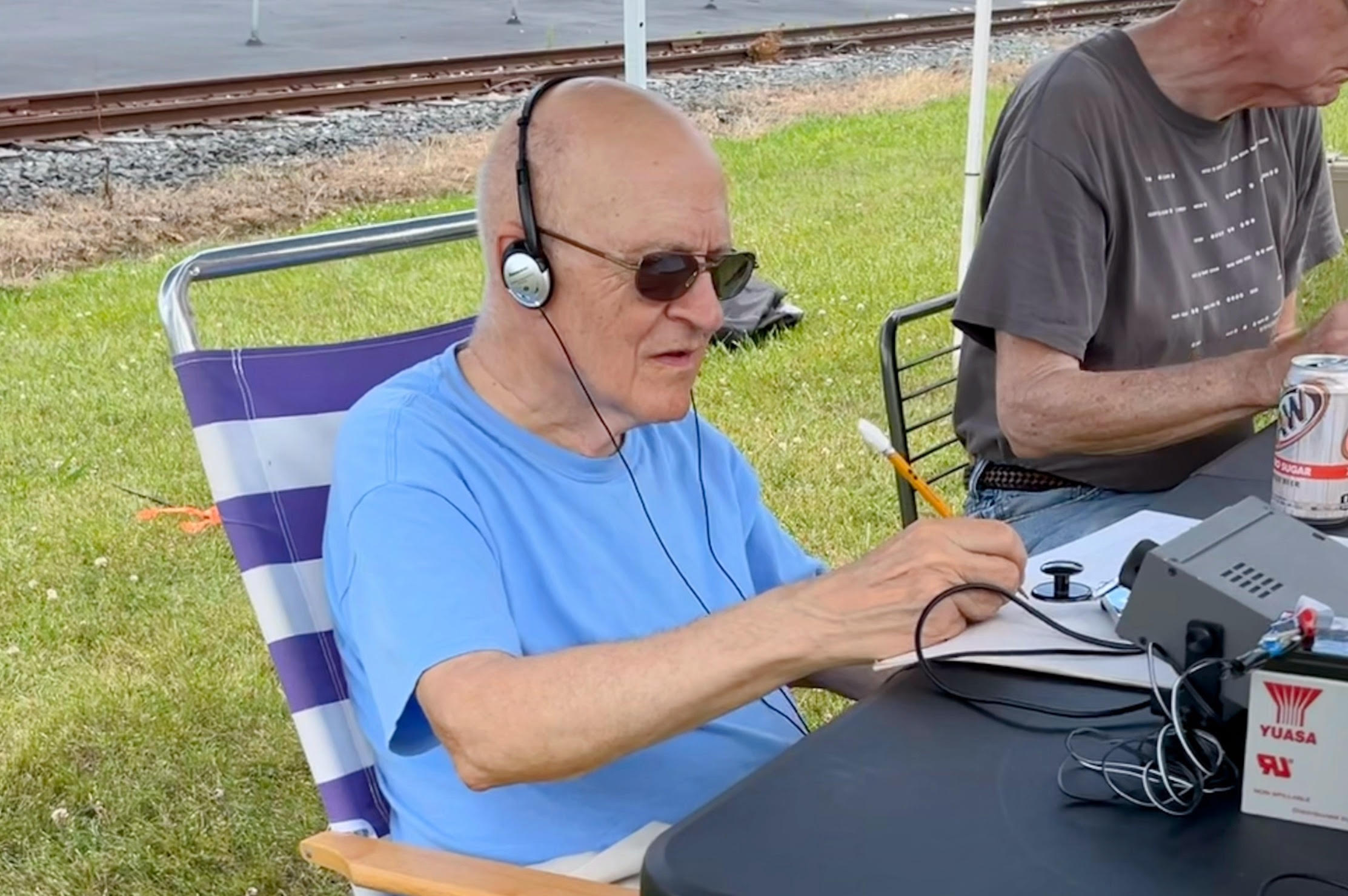 n many states and countries John is logged into amateur radio log records as John, NQ4Q, his amateur radio station identification. His dedication to amateur radio and to fellow amateur radio enthusiasts is witnessed by service as president of the Delmarva Amateur Radio Club, as a Volunteer Examiner testing applicants for amateur radio licenses, as net control for the Quarter Century Wireless Association, Chapter 150 radio group, participation in amateur radio communication events, his knowledge as a telegrapher and use of morse code in radio communication, as an Elmer (one who trains and helps others learn), and friendships with other amateur radio operators both on the air and during get-togethers in person.
As president, John directed meetings of the Delmarva Amateur Radio Club, once a month for eleven months out of the year, two of which were at a restaurant and maintained the club’s membership records. In conversation John could hold his own during conversations about old radios and types of vacuum tubes used in them. His involvement and knowledge of radios goes back several decades.
As a volunteer examiner under the auspices of Al, K3TKJ, test administrator, John perused test answers, as one of three examiners, to verify that an applicant for an amateur radio FCC radio license passed or failed the amateur radio license test. In the past Delmarva Amateur Radio Club testing occurred at a television station location in the KMart parking area. More recently, John participated in test sessions as a volunteer examiner, offered by the Worcester Radio Group in Berlin, MD and at the Expo, “ham fest” in Georgetown, DE.
On Sunday morning at 9 a.m. on the frequency 146.820 MHz, John would come on-the-air announcing the Quarter Century Wireless Association Chapter 150 net and apply standard procedures utilized in net control to carry on about a half hour on-the-air meeting of those who called in to participate. He first acknowledged call-ins by call sign and first name and later reviewed the gathered list for each amateur’s comment for the day. After each had an opportunity to speak, John returned the frequency to regular amateur use.
John regularly attended amateur events, field days and the yearly ham fests in Georgetown, Delaware. The Georgetown hamfest is a gathering of hundreds of amateurs with participation of companies that sell gear and equipment to amateurs. He usually manned the Delmarva Amateur Radio Club table to sell amateur radio accessories offered by club members on one or two tables. John attended an event sponsored by the Delmarva Amateur Radio Club three times per year in recent years, which took place in Laurel, Delaware at a location offered by Al, K3TKJ. The event is called a “swap meet,” a kind of yard sale by tailgaters of amateur radio equipment, sold from the backs of pickup trucks and from cars
John knew a lot about amateur radio and enjoyed the event to renew acquaintances with friends and people with whom he had communicated on the air.
Years ago, John obtained radio licenses when morse code was a license requirement, 5 words per minute, 13 words per minute and 20 words per minute for the highest license level. By his own words, John was not especially enamored with morse code, but the challenge of it grew on him and in time morse code became his favorite means of radio communication. John claims to typically send morse code at a rate of 18-20 words per minute with a straight key, pressing downward to close a circuit to form long and short bursts of sound for morse code letters of the alphabet. John also claimed the ability to receive morse code at a rate of 30 words per minute – that is akin to a slowly worded dictation. In the field John operated QRP (meaning low power), transmit power under 5 watts, using a battery power source.
The amateur radio hobby offers opportunities to socialize with others in person as in ham fests, field days, club meetings, and arranged get-togethers in small groups. John would meet with the few remaining members of the Quarter Century Wireless Association Chapter 150 club at a designated location joined by membership of a Lewes, Delaware amateur radio club and they would enjoy restaurant meals together.
John, as a member of a homeowners’ association, had restrictions on outdoor antennas, so John installed antennas in the attic with a remote switch to change from one antenna to another. He was not well equipped with a good antenna set up for use in the field. Neill, K3RNC and I, Arthur, N3EAK helped John out a few times with field antennas to use. John patiently listened for stations to send to and over the course of several hours would have a list of contacts, usually a short list, but he persisted and enjoyed the endeavor.
John, NQ4Q, has a legacy. On Sunday morning at 9 a.m. Kenny, KA3DCO, net control, will take roll calls on 146.820 MHz from his station location in Cambridge, Maryland and follow John’s NQ4Q format for the Sunday morning net.
On December 10, 2023 John C. Willmuth, NQ4Q, became in the vernacular of amateur radio, a silent key, meaning a deceased telegrapher. John, NQ4Q, will remain in the memories of the many who knew him. He made many friends through his interest in radio communication and his dedication to others.